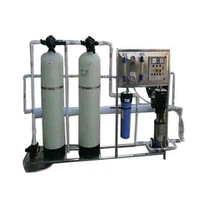
It uses the exchangeable cations (such as Na+, H+) in the cation exchange resin to exchange the calcium and magnesium ions contained in the water to reduce the hardness of the water.
The ion reaction formula is: Ca2++2RNa=R2Ca+2Na+, Mg2++2RNa=R2Mg+2Na+. In the process of ion exchange softening, when the effluent water quality exceeds a certain value, the ion exchange resin in the exchanger will be regarded as "failed".
At this time, in order to restore the exchange capacity of the resin, the resin is usually regenerated with an industrial brine solution. The reaction is: R2Ca+2NaCL=2RNa+CaCL2, R2Mg+2NaCL=2RNa+MgCL2
1.Select ion exchange resin, with large working exchange capacity, low energy consumption and long service life.
2. All control parts adopt Fleck control valves to ensure the continuous and safe operation of the equipment. Power position control points: flow control, water production control, failure control, regeneration control (salt intake and water replenishment control), salt liquid control, salt liquid dilution automatic water replenishment control.
3. Fully automatic control system, stable water output, convenient and quick operation. (Set the recovery period as needed within 7 or 12 days, choose the recovery time arbitrarily within 24 hours, and adjust the recovery process)
4. Reasonable structure, convenient installation and operation.
5. Corresponding equipment can be individually designed according to actual needs.
Reverse osmosis system has a high desalination rate and is suitable for projects with large amounts of water, but the treatment is not thorough and the one-time investment is relatively high.
Ion exchange, the treatment is more thorough, but the operation needs to be regenerated, the operation cost is higher and the operation operation is more cumbersome. If the treated water volume is large and the water quality requirements are high, it is recommended to use the process of reverse osmosis + anion and cation bed.